How to Choose the Right Compression Spring: Principles, Design, and Common Types
What Are Compression Springs?
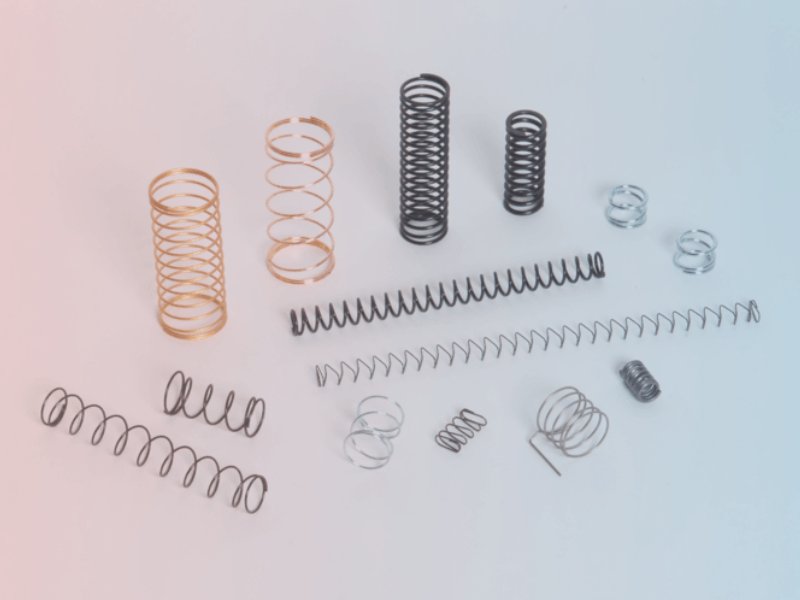
Compression springs (also known as compression coils) are the most common type of spring. They are formed from metal wire wound into a helical coil structure.
When subjected to an external force, the coils compress and store energy. Once the force is released, the spring generates a restoring force that returns the component to its original position.
This characteristic allows compression springs to provide stable support, reduce impact, and absorb vibration, making them widely used in various mechanical equipment, electronic products, and precision devices.
Structure and Specification Parameters of Compression Springs
The performance and dimensions of compression springs are closely related. During the design process, factors such as service life, load requirements, and restoring force must be evaluated.
Common compression spring specification parameters include wire diameter, outer diameter, inner diameter, length, and number of coils. Each parameter affects the spring’s strength and elasticity.
1. Wire Diameter
Wire diameter refers to the diameter of the metal wire used to manufacture the spring.
The thicker the wire diameter, the greater the force the spring can withstand. However, it will also affect the elasticity and compressible space of the compression spring.
Smaller wire diameters are more suitable for precision components and light-load applications.
2. Outer Diameter
Outer diameter refers to the diameter of the outermost coil of the compression spring.
If the spring needs to be installed inside a hole or specific structure, the outer diameter must match the installation space to avoid assembly issues caused by oversized dimensions or insufficient clearance, which may lead to friction and unstable operation.
3. Inner Diameter
Inner diameter refers to the diameter of the inner space of the spring.
If the compression spring needs to be installed over a shaft, attention should be paid to the inner diameter size to ensure stable operation during compression and rebound without interfering with surrounding components.
4. Free Length
Free length refers to the length of the compression spring when it is not subjected to external force.
The free length affects the available compression space. If the length is too long, it may cause insufficient compression space; conversely, if it is too short, it may not provide sufficient support and rebound travel.
5. Pitch
Pitch represents the distance between two coils.
The pitch is related to the spring’s compression travel and load performance. It should be adjusted according to the required travel and load conditions. Improper design may result in insufficient space during compression.
6. Active Coils
Active coils refer to the number of coils that actually provide spring force.
They affect the spring rate and load performance. The greater the number of coils, the softer the spring becomes; fewer coils result in higher spring stiffness.
Common Compression Spring Types
Cylindrical Compression Springs
Cylindrical compression springs have a constant outer coil diameter throughout the entire length of the spring, allowing force to be distributed evenly.
When subjected to compressive force, the spring stores energy and returns to its original length once the external force is removed.
Due to their simple structure and stable load performance, they are commonly used in electronic products and mechanical equipment.
2. Conical Compression Springs
Conical compression springs have an outer diameter that gradually increases or decreases from one side, forming a cone-shaped structure.
During compression, the coils can nest into each other one by one. Compared with cylindrical compression springs, they can provide different spring forces at different stages of compression.
Barrel Compression Springs
Barrel compression springs have the largest outer diameter in the middle section and smaller diameters at both ends.
This design improves stability during compression and helps reduce bending or tilting when force is applied.
Applications of Compression Springs
Compression springs are used in various industries, including precision electronic components, lighting equipment, optical instruments, medical devices, automotive and motorcycle parts, and various hardware tools.
For example, in electronic products, compression springs can be used in buttons, contacts, or battery terminal structures to provide rebound force and conductive contact functions.
In the automotive and motorcycle industry, they are commonly used in clutches, shock absorbers, valves, and mechanical transmission components.
In medical devices and precision equipment, miniature, high-precision, or special-material compression springs are used according to product requirements.
We provide custom compression spring design and manufacturing services according to customer requirements, supporting customizable wire diameters ranging from 0.1 mm to 8 mm.
We are able to accommodate both small-batch and large-scale production. All products undergo precise testing, and through professional design and manufacturing techniques, we ensure stable elasticity and durability to meet the needs of various industrial equipment and precision products.
For more information about product specifications or to request a quotation, please feel free to contact us.
Watch the Compression Spring Manufacturing Video